The dahlias are blooming now. They make a lovely view during lunch under the grape arbor -- here with our friends Carol and Art and their daughter Diana.
Showing posts with label Garden. Show all posts
Saturday, July 3, 2010
Lunch with Friends in the Garden
The dahlias are blooming now. They make a lovely view during lunch under the grape arbor -- here with our friends Carol and Art and their daughter Diana.
Wednesday, April 7, 2010
Perry takes inventory
Until no
w, we've just planted and nurtured tomato seeds, carefully labeling which are which, but without regard to how many we have. Our "eyeball estimates" have led us to think we have 150-175 tomatoes of 35-40 varieties. Well, today Perry did an inventory of the tomatoes, in part to get a more concrete idea of what we've got, and in part to make a determination of what tomatoes we should put in the ground "early" (i.e., this week). It would also be helpful to know how many of what tomato colors and sizes we'll have.
Here's the result. As of today, we have 375 plants representing 58 varieties. And colors? We will have red, orange, yellow, black, green, and all combinations. Perhaps we should think about showing up at Farmers' Markets and selling tomato plants, or, later in the season, tomatoes.
Tuesday, April 6, 2010
The Ins and Outs of tomatoes
By last approximate count, we have over 150 tomato plants of about 40 varieties growing in small pots. By night, they rest on the ledge in the garage in temperatures around 55 degrees, and catch a couple of hours of warm morning sun through the windows of the garage. Each morning, we carry them out into the garden and let them bask in the direct sunlight for several hours, before bringing them in again in the late afternoon.
There are just three problems with this routine. First, as the tomatoes get repotted again and again into larger and larger pots, they are getting heavier to schlep in and out every day. Second, larger pots means more shelf space required for the nighttime beds, and we're out of shelf space. (We've got some flats of eggplant seeds sprouting in the garage, also.) And finally, some of us (i.e., Perry) can't wait to get some tomatoes into the ground. So today, he put in five plants in the sunniest spot in the garden: a Pineapple (red and yellow, up to 2 pounds), a Hawaiian Pineapple (golden-orange, up to 1.5 pounds), an Earl of Edgecombe (medium-sized, round, orange), a Marizol Red (1-pound large, bright red), and a Chocolate Stripe (3-4 inch, mahogany colored). These are some of the sweetest, best tasting, and best for BLTs and caprese salads...and we have lots of the plants still growing in pots.
Saturday, April 3, 2010
Pleased with peas!
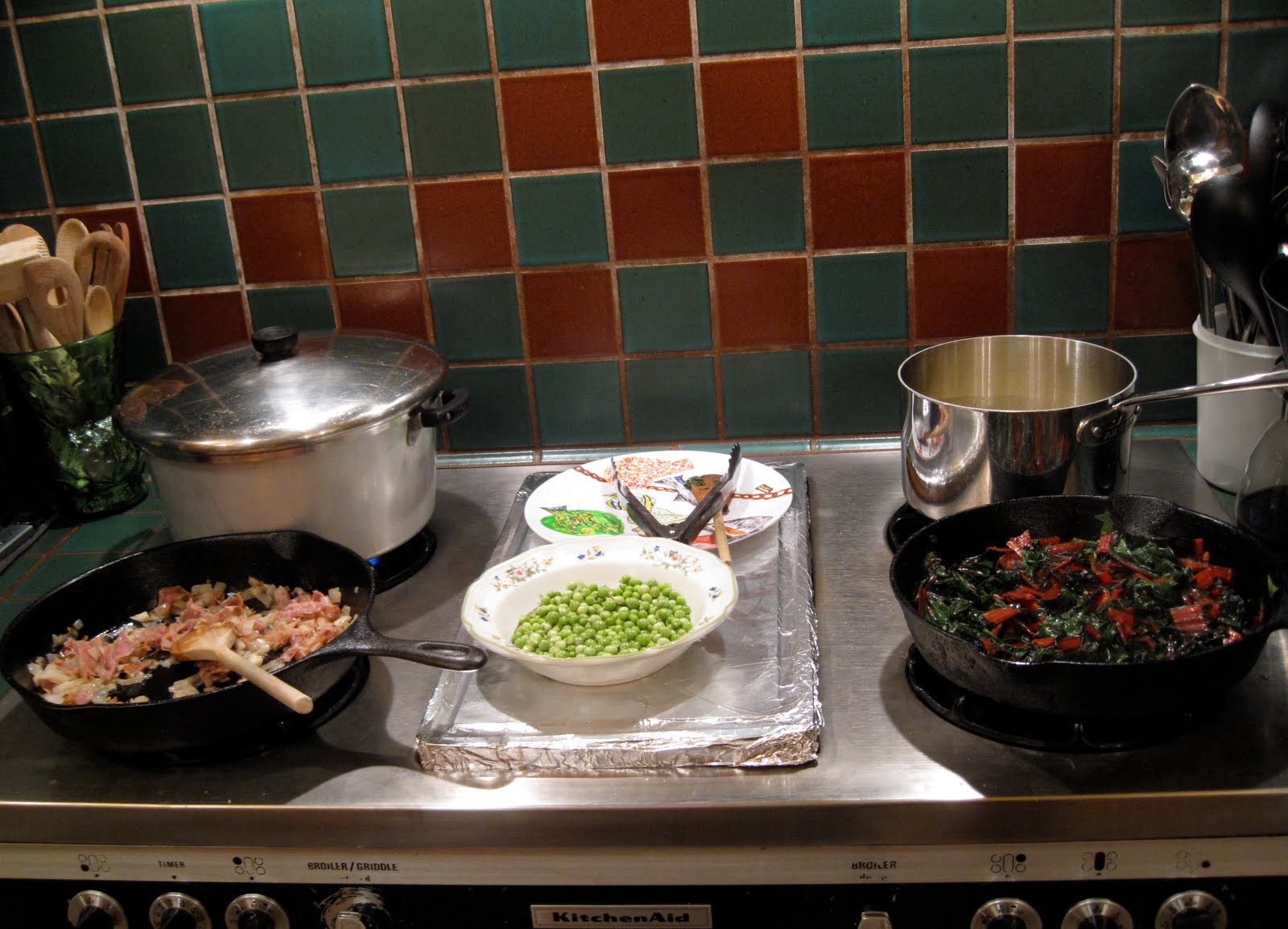
Our first gathering of peas wasn't quite enough for a stand-alone bowl of steamed green pearls, so we dressed up the peas with some sauteed onions and proscuitto, and tossed them with farfalle and
parmesan to create a wonderful first course of Farfalle Con Proscuitto e Piselli.
But then, a few days later, we had so many peas that we just had to make an entire bowl of them. Here's how: we picked a scallion from the garden, chopped it and sauteed it in butter, then stirred in the steamed peas with salt and pepper. We served the peas alongside some veal marsala, and a salad of greens just cut from the garden. Fantastico! Bella was quite pleased with the outcome, as you can see!
Saturday, March 20, 2010
No rest for the weary
As usual, we are
And these are just the annuals. Don't forget the forget-me-nots. And don't forget the hollyhocks, the dahlias, the roses, the gladioli, the lilies, the lavender, ...
But really, can you ever have too many flowers?
Friday, March 19, 2010
When March is wet, seeds will sprout, we bet
Coming from Southern California, 10-week-old Tess was surprised, but not unpleasantly, by our March rain. She also told us that she really likes matching shoes and jackets--Bella's green ones and her own white ones.The rain has been coaxing all of our recently planted seeds to sprout: second crops of spinach, lettuce, arugula, escarole, bok choi, green onions, and chives, and new crops of fennel, radishes, mint, and two kinds of beets--tri-color and golden beets (which even Rick will eat).
And of course, peas. This year, we went hog-wild with peas. We started with 36 feet of tomato trellises. (The tomatoes will go in after the peas come out.) With 1 vine every 2 inches on both sides of each trellis, that is 432 pea plants and a whole lotta peas. Not content with this, a few later, we put a row of bush-style peas between every pair of trellises, for a total of 180 pea plants and a whole lotta more peas. Still not content, a few weeks after that, we lined the edges of our dahlia boxes with double rows of short vines, for a total of 480 pea plants and a whole lotta more peas. (Actually, we seem to have left about 2 row feet bare... So make that 468 pea plants.) Those
plants are about 3 inches tall now.
Of course, we did not plant just one kind of peas. It's true
We just love shelling peas. We especially love the French petit pois, which are packed so snugly, shoulder-to-shoulder in their pods. But we also packed a few other varieties of shelling peas that come in earlier than the petit pois.
With our succession plantings, we figure we will have pea shelling parties every 2 weeks during April and May! Of course, we won't be able to eat all of these peas fresh. We'll freeze most of them for next winter. It is easy to freeze peas--just par-boil them and throw them in a freezer box or bag. And they will be wonderful!
There is another reason to fill empty areas of the winter garden with peas. They are nitrogen-fixing plants. That means that, instead of depleting the soil, as most vegetables do, peas actually improve the soil for the tomatoes and other vegetables that will follow them.
Oh, there is one other kind of peas we planted -- sweet peas. Flowers, that is. We put them in a nice new 6-inch tall box that Perry and Aaron planted along our picnic area. We hung a net down the center of the box so that in the spring we will have a wall of delicately scented sweet peas.
Sunday, March 14, 2010
Stroke those tomato seedlings
While nurturing our tomato seedlings in their nursery in the garage, we try to simulate natural growing conditions as much as possible. Daytime sunlight, nighttime warmth, and regular watering are the obvious requirements. But we recently learned that tomato seedlings also benefit from al fresco breezes ruffling their leaves and bending their stems. Apparently, this "exercises" them and makes them grow stronger. To simulate natural breezes, we gently stroke our seedlings 3-5 times a day, whenever we pass through the nursery. They seem to like it!
Tuesday, March 2, 2010
Daffodils are signs of spring
| I wander'd lonely as a cloud |
| That floats on high o'er vales and hills, |
| When all at once I saw a crowd, |
| A host of golden daffodils, |
| Beside the lake, beneath the trees, Fluttering and dancing in the breeze. -- First stanza of "The Daffodils" by William Wordsworth |
In the Bay Area, paper-white daffodils appear in December. That's right. On the shortest, coldest, wettest, darkest days of the year, when everyone in our house gets just a little bit cranky, daffodils appear in the garden to reassure us that the light will come again. This is cause for celebration. We pluck the perky flowers as soon as they appear and bring them into the house, where the warmth calls forth their heavenly scent.
Since you can never have too many daffodils, we planted a few hundred bulbs on a small hill (very small) in our garden, beneath an arcade of ancient California live oak trees. That's our "daffodil hill." The oaks allow filtered light all summer, just what the braided leaves of our spent daffodil plants need in order to put away food for next year's flowers.
We planted several varieties of daffodils -- early, mid, and late-blooming. When the paper-whites finish in early January, the next-blooming variety is just starting to blossom. So it continues through February and March.
We planted each daffodil variety in several clusters of 3-5 bulbs and spaced the clusters 2-3 feet apart. The bulbs "naturalize," multiplying each year and filling in the gaps between the clusters to form great swaths of color and texture across our daffodil hill. As the great English gardener Gertrude Jekyll advised, our daffodils "look happy and at home, and make no parade of conscious effort".
Wordsworth's "host of golden daffodils" no doubt refers to the iconic King Alfred daffodil, familiar to all for its huge golden trumpet and great surrounding collar of petals. Somehow, we neglected to include King Alfred on our daffodil hill. We have many colors of flowers -- yellow, white, orange, even pink. We have large and small, plain and ruffled flowers. But no King Alfred. Perhaps next Fall, when we add a new variety or two, King Alfred will be among them.
Friday, February 26, 2010
Make room for tomatoes!
This week the tomato plants are multiplying at both an alarming and satisfying rate. Beginning with one flat planted with multiple seeds in each of 35 cells, we transplanted the sprouts into many, many plant packs. We must have about 150 tomato plants now representing about 40 different varieties.
But where to put them when it's time to transplant them into the ground? Our ready-made trellises in the raised beds, destined to accommodate the tomato plants after the harvest of peas growing on them now, are insufficient for all of these tomatoes. So, over the past two days, we've created a new planting bed that will hold three new rows of trellises and about 60 tomat
To create this new bed, we hoed the weeds and turned over the soil. Then, all of the grass clippings from the lawn this week were laid down over the bed. We like to use grass clippings (and, in the autumn, leaves) to build new soil through composting. The grass is a good source of composting material because it is clean (we don't use pesticides on the grass) and it gets hot as it decomposes, thus warming up the soil. After the grass was spread over the soil, it was worked into the existing soil to turn the grass into the soil. Then, Perry hauled quite a few wheelbarrow-loads of organic compost (an aged, cured mixture of redwood tailings and horse manure) from the driveway to the new bed, and spread it over the planting area. Finally, the area was sprinkled with a lot of coffee grounds (good source of acid) obtained from the local Peets Coffee. Voila! Add a little chicken wire to create the trellises, and a new planting bed will be ready to go! Here are the photos before, during, and after this process. In a few weeks, when the tomato plants are ready to go into the ground, the ground will be ready to embrace the little plants.
Tuesday, February 23, 2010
Aaron ties up the peas
When Aaron comes to visit, he always grazes on whatever vegetables or herbs are mature. He also looks for projects to do that involve planting or transplanting, cultivating, preparing the beds, and so on. Last week, he tied up the pea plants that are now almost four feet high.
Time to get going with tomatoes
Perhaps the most special food crop one can grow in a garden is tomatoes. The varieties, colors, sizes, textures, shapes, and flavors are so numerous! And "heirlooms" purchased in a grocery in season, assuming they're available at all, are limited in type and priced at $9 per pound and up. That's $9 per tomato!
We started in early February, sprouting about 35 different varieties of tomatoes in flats placed next to a window in the garage that gets morning sun. Each cell has about 8 seeds in it, so if we get 4-5 seeds sprouted per cell, that will be upwards of 120 plants! In a few days, we'll separate the sprouts and repot them into larger pots, still keeping them growing indoors (for now).
So, give it a go! There are several suppliers of heirloom tomato seeds that you can find on the Web. (See, for example, www.tomatofest.com.) They're easy to sprout from seeds, and you'll have enough plants to give some away, and still keep yourself in BLTs and insalate caprese all summer.
Subscribe to:
Posts (Atom)